
Vagus Vibe
An iPhone app that buzzes slow, calming rhythms through your phone. A cheap way to test vibration; the "heal" and "vagal massage" claims have nothing behind them.
An iPhone app that buzzes slow, calming rhythms through your phone. A cheap way to test vibration; the "heal" and "vagal massage" claims have nothing behind them.

It's ten to eleven, you're on the couch, and your phone is lying on your breastbone, buzzing slowly like a cat that has decided you're acceptable. Twenty minutes ago an ad offered you a $448 vibrating wristband. Then you found an app selling the same idea, on the phone you already own, for $19.99.
So is it a bargain Apollo, or just a phone on your chest? A bit of both.
Vagus Vibe arrived on the App Store in August 2025. Its developer, Lazy Loop AB, is a one-employee software consultancy in Linköping, Sweden; its website gives the app only a logo and a privacy note. We found no product website or Android version. It's unrelated to VaguVibe, a separate hardware device.
You pick a pattern, set the intensity and length, and the phone buzzes in that rhythm, with music if you like. You can also design patterns, keep a streak and log sessions to Apple Health. The subtitle promises "vagal massage using your phone"; reviewers hold it wherever they feel tense. The store description is more modest: it never mentions the vagus nerve and says the app is "not a medical device."
Partly. A phone vibrates with a tiny motor tuned to one sweet spot. Apple doesn't publish the iPhone's figure, but Android's developer guide puts these motors at around 150 Hz or 200 to 300 Hz, weakening the further you push them from it. So a phone can tap out a slow pulse at almost any pace. It can't make a deep, low hum with much force.
That matters more for Sensate, which describes "subaudible" frequencies resonating through your breastbone, than for Apollo, whose pitch is about rhythm. Tellingly, Apollo sells its own phone version, Apollo Sessions; its co-founder launched it by inviting people to imagine "placing your phone on your chest." Apollo still says the wearable gives "deeper benefits," and its studies tested the wearable.
Not directly, whatever the name says. The vagus nerve runs deep through your neck and chest; the only place it reaches the skin is a small patch of your outer ear. A phone on your breastbone is felt by ordinary touch nerves.
Any effect would be indirect, like a hand on your back: your brain reads slow, steady rhythm as safety, and your body may follow. The Haptics covers that idea.
It's touch. The vagal part, if any, is secondhand.
Vagus Vibe itself: nothing. We found no studies, and the listing cites none.
Rhythmic vibration in general: small, early and mildly encouraging.
The paid devices aren't much better proven. Apollo's published studies are small and several are company-linked; Sensate's are mostly its own pilots. None of this research tested a phone lying on someone's chest.
Slow, rhythmic touch may take the edge off for some people. Whether this app's patterns are the right kind of slow, nobody has checked. More on reading studies in the Science.
As of October 2026, Vagus Vibe has 4.4 stars from 18 US App Store ratings. We read all ten written US reviews; we found no Trustpilot page, Reddit thread or independent review.
Fans like the price next to $300-plus devices, the music and the strong buzz; one compared it to their Apollo. Some say it helps them sleep; one felt more grounded after three sessions while wondering, fairly, if it was placebo. Complaints: one free pattern to judge it by, a trial that locked someone out early, slow startup, and an alarm that silently stopped the vibration while the timer ran on (one reviewer suggests a Focus mode).
Another said it helped more than their prescription medication. Please don't change medication without your doctor.
Prices as of October 2026.
If the phone does nothing for you, I'd think hard before paying ten times as much for the same idea in nicer packaging.
Lie down, rest one hand flat on your chest and hum on a long, slow exhale, five or six times. That buzz under your palm is the free version of what this app and the devices sell, plus a longer out-breath, which is the part with real evidence.
If humming does nothing for you, $19.99 of phone buzz probably won't either. More free options are in the Analogs.
Not directly. The vagus reaches the skin only in the outer ear. Any calming effect comes through touch.
Possibly. Small studies suggest slow, heartbeat-like vibration eases anxiety for some people. None tested a phone on the chest.
Nobody has compared them. Apollo's own phone mode suggests a phone can carry its rhythms, though Apollo says the wearable does more. The app costs $19.99 (as of October 2026); Apollo, $448 plus $99 a year.
Vagus Vibe is a modest experiment wearing an overpromising name. A phone buzzing on your chest doesn't heal anything or massage your vagus nerve. But rhythmic touch calms some people, the paid devices haven't proved much more, and $19.99 is the cheapest way to find out whether you're one of them. Skip it with a pacemaker, keep the patterns slow, and I'd call it fair.
Or start with your own hum. Same buzz, no download.
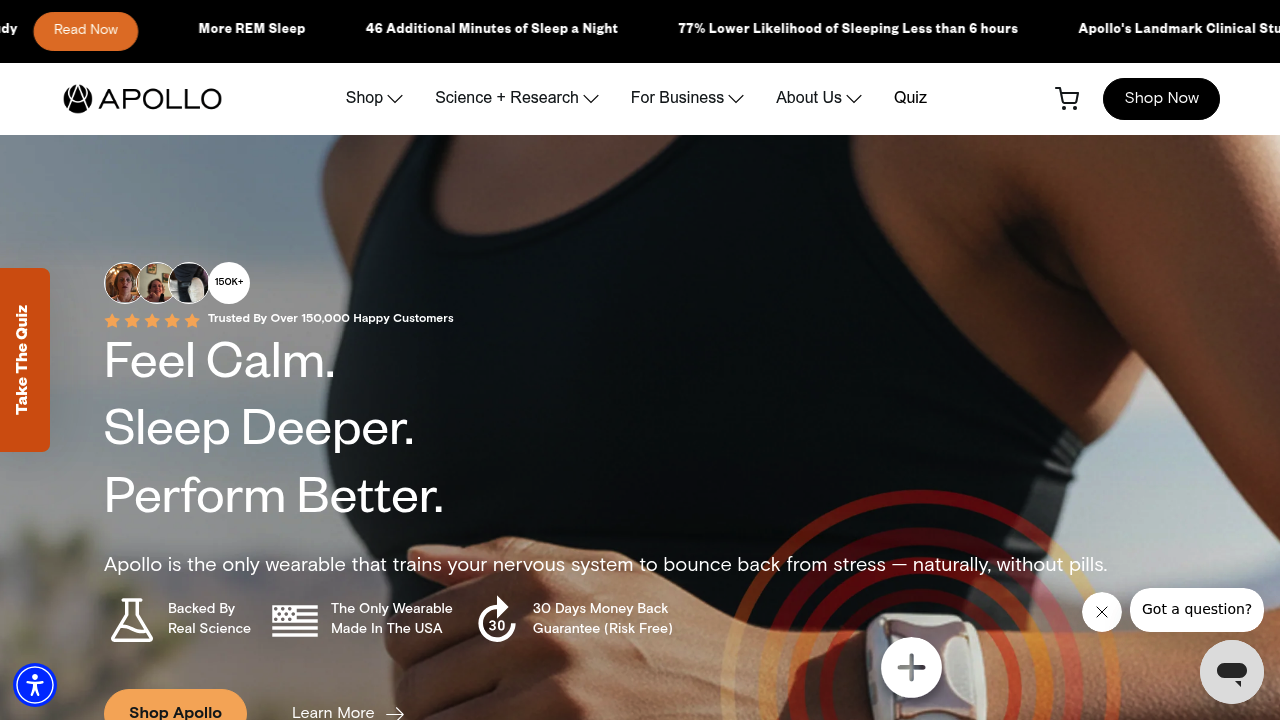
A vibrating band or clip that aims to calm your nervous system through touch. Gentle and low-risk, but pricey, tied to a subscription, and backed by small studies.

A humming pebble you rest on your chest while soundscapes play in your headphones. Gentle and easy to like, but the research is small and mostly the company's own.
Two buzzers that tap left, right, left, borrowing an idea from EMDR. Simple and app-free, but "74% in 30 seconds" comes from customers rating themselves.