NEUROFIT
A daily check-in, fingertip HRV scan and short movement exercises. The camera reading holds up at rest; "relief in 7 days" rests on the company's own uncontrolled data.
A daily check-in, fingertip HRV scan and short movement exercises. The camera reading holds up at rest; "relief in 7 days" rests on the company's own uncontrolled data.
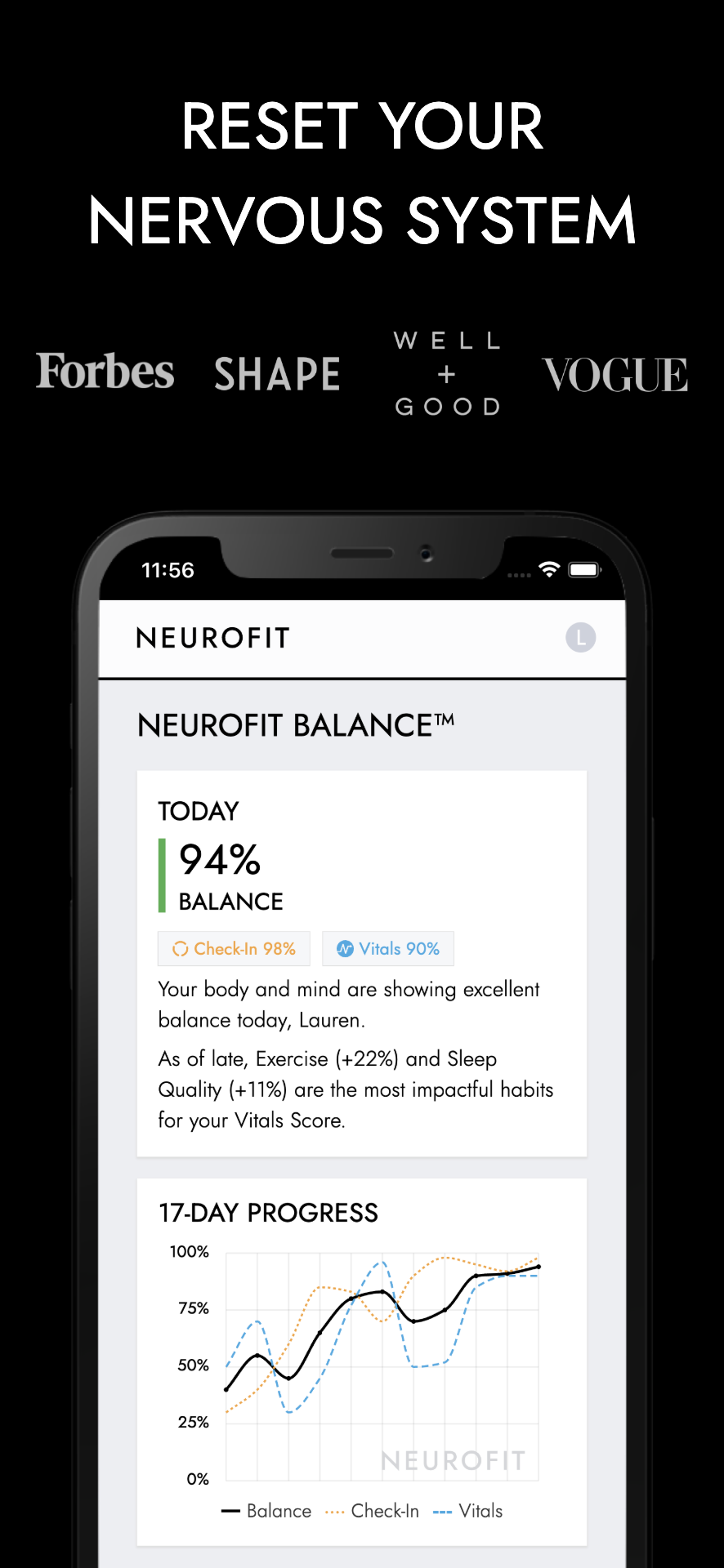
It's 6:45am, you've been awake since 3, and before coffee an app wants you to rate your career, relationships and finances on a little ring. Then it asks for your fingertip over the camera for a minute and hands you a three-minute exercise. Maybe shaking out your arms. Maybe jumping jacks.
If a racing heart is why you quit meditation apps, a body-first approach makes sense. But does "relief in 7 days" hold up, and is it worth up to $180 a year?
NEUROFIT is made by Xama Technologies, Inc., registered in Delaware; Business Insider called it a New York startup. Its founders are Loren Hogue, a former lawyer turned somatic coach, and Andrew Hogue, a Caltech-trained engineer who worked at Snapchat and Headspace.
Its terms say it isn't a medical device and is for "informational and entertainment" use, yet the App Store listing pitches it for anxiety and sleep.
The "relief in 7 days" claim. It comes from a NEUROFIT whitepaper on 16,487 users (2023 to 2025), analyzed by a biostatistician the company engaged as an independent advisor. (The homepage credits "Harvard Medical School" next to her name; that appears to be where she trained, and we found no Harvard study.) Scores on NEUROFIT's own eight-question stress scale fell 39% on average by day 7. But there's no comparison group, it isn't peer-reviewed, and only a quarter of users had a day-7 check-in (6% by day 35). To its credit, the whitepaper says plainly that it can't separate the app's effect from natural recovery or expectation.
The marketing is less careful. The App Store says its average active user reports "54% less stress" after a week, a figure we couldn't trace. NEUROFIT's efficacy page compares its uncontrolled numbers with other apps' randomized trials while conceding that trials typically show smaller effects, so the comparison flatters it. Terrible weeks often ease on their own.
Camera HRV: decent, at rest. In a 2017 study of 29 healthy adults at rest, a smartphone camera app's HRV agreed acceptably with an ECG; a 2013 review found pulse-based HRV fine at rest but thrown off by movement and some mental stress. NEUROFIT's interim report (October 2026) compared 30 people against a Polar H10 chest strap: accepted readings were off by 3.4 milliseconds on average.
The fine print: the test was in-house, the system was tuned on those same 30 people, only three were 45 or older, and the company estimates about 9% of real-world scans end without a number. Frequent extra heartbeats make HRV unreliable even on a chest strap, and the camera can't yet flag them. Worth knowing if your 3am palpitations are skipped beats.
The exercises. Slow breathing has the strongest support: a 2022 review of 223 studies found it raises vagus-linked HRV, and a 2023 meta-analysis of 12 trials found breathwork modestly eased stress. Shaking's closest studied cousin, Trauma Releasing Exercises, got a 2026 scoping review of 22 studies: promising, not consistently rigorous. NEUROFIT's articles also suggest cold water on the face and humming, both covered on our Analogs page: cold water triggers a real reflex; humming's research is thin. The rest is ordinary movement. Unlikely to hurt, never tested as a package.
The polyvagal map. The six states (ventral vagal, sympathetic, dorsal vagal, plus play, stillness and overwhelm) come from polyvagal theory, which NEUROFIT presents as settled without mentioning that researchers dispute some of its core claims. The Science treats it as a useful map with an asterisk. Your "state" comes from your answers, not a reading of your vagus nerve.
As of October 2026, NEUROFIT has 4.8 stars from 724 US App Store ratings and 4.4 stars from 445 Google Play reviews. Trustpilot and Reddit blocked our checks, and we found no independent expert reviews.
Fans like the short exercises, check-in reminders and CLEAR. A striking share of glowing reviews come from coaches, therapists and somatic practitioners, several of whom mention NEUROFIT's coaching certification.
Complaints cluster around paying before trying (reviewers say the trial needs card details and little works without it), the $19.99 monthly price, HRV scans that won't register on some Android phones, and silent exercise videos. One 2026 reviewer found the advice shallow; a few describe billing or refund trouble.
I'd turn on Privacy Mode before telling a chatbot anything you wouldn't put in an email.
Prices as of October 2026.
Do your own check-in. Which traffic light are you on: red (wired, racing) or blue (flat, foggy, numb)?
If it's red, especially at 3am, breathe in through your nose for four and out for six to eight, for five minutes. If it's blue, try something gently activating tomorrow, like shaking out your arms or a brisk walk. Then rate how you feel, one to ten.
That's the NEUROFIT loop: notice, choose, act, check. If it works on your own, you've saved $125. If you keep forgetting, the reminders are what you'd be paying for.
Many users say it helps, and the company's data shows self-reported stress dropping within a week. Without a comparison group, nobody knows how much of that is the app.
For people who need structure and reminders, possibly. For most, the core tools are free. I'd pay only if the trial convinces you, with a reminder set before it renews.
At rest, reasonably: within about 3.4 milliseconds of a chest strap on average in the company's own test. That test was small, in-house and mostly under-35s.
NEUROFIT packages sensible things (slow breathing, shaking off tension, a daily pause) into a polished app whose camera HRV holds up when you sit still. Its weak spot is the evidence it leads with: big percentages from its own users, no control group, and a store listing that outruns its whitepaper. At up to $180 a year with no refunds, I'd try the free loop first.
Notice, breathe, move. Start there tonight.
